
Pillar: Community & Governance
The Privilege of Founding a Sovereign Ecosystem
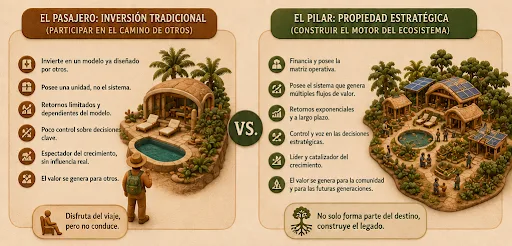
In the history of land development, most people arrive when the road is already traced. They invest in a finished model, receive its returns and become passengers of someone else’s vision. A much smaller group does something different: it builds the engine.
At that level of vision, the conversation is no longer about a fully passive investment. It is about financing and guiding a community, and about becoming a long-term partner in the creation of the project.
Why so few founders
Limiting the founding of the ecosystem to a small number of partners is not an exercise in frivolous exclusivity. It is a decision about efficiency and coherence: too many decision-makers in the early years produces paralysis, while too few produces dependence.
A founding group needs to be small enough to agree quickly and diverse enough to cover the critical disciplines of the territory: water, construction, governance, finance and care.
The engineering of commitment
Founders do not simply contribute capital. They underwrite the conditions that allow the rest of the community to arrive later with confidence. That means accepting responsibilities that are invisible in a brochure: legal structure, maintenance reserves, conflict resolution and continuity plans.
What founders actually fund
- Critical infrastructure: water capture, storage and treatment, and decentralized energy.
- Administration and governance: written rules, assemblies and transparent accounting.
- The reserve that absorbs slow seasons without selling the territory’s foundations.
A different kind of return
The returns of founding a sovereign ecosystem are partly financial and partly structural. The financial ones appear as the place matures. The structural ones appear earlier: a community that knows who decides, how resources are administered and what happens when something breaks.
In Yucatán, that difference is visible in the landscape. A project built on commitment looks like a place that can be repaired by the people who live in it.
Founding is a privilege precisely because it is a responsibility, not a title.