
Pillar: Community & Governance
The Human Software of Regeneration: Why Talent Matters as Much as Capital
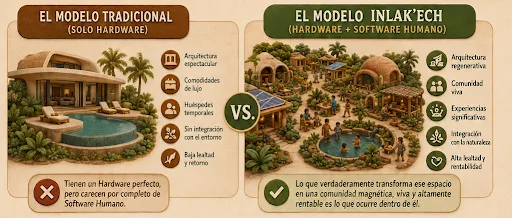
Visit the most exclusive ecotourism developments in the world and a pattern appears. Many achieve remarkable architecture and first-class amenities, yet they feel sterile. They are beautiful shells in the middle of nature, briefly inhabited by strangers who neither interact with each other nor with the surroundings.
They have perfect hardware, and no human software connected to social reality.
Perfect hardware, empty software
In the design of a sovereign ecosystem, infrastructure (water, energy, earth walls) is only the platform. What makes the platform live is the people who know how to use it, repair it and teach others to do the same.
That knowledge is not decorative. It is the difference between a resort that closes when the season ends and a community that continues to function in the off-season.
Artisans as anchoring infrastructure
We call this role the anchoring artisan: the person who knows the materials, the cycles and the local networks, and who can turn an abstract design into a lived practice. Their work is simultaneously technical, pedagogical and social.
What anchoring looks like in Yucatán
- Building and repairing with local earth, limestone and palapa, adapted to the humidity and the rains.
- Managing water and forest with knowledge that predates the project and will outlast it.
- Teaching residents and visitors how to maintain what they use, so knowledge does not leave with the season.
Investing in the people who hold the place
Capital builds the container; talent keeps it inhabited. A regenerative development that does not invest in local capability ends up importing its own maintenance, and with it a permanent dependency.
The most durable investment in a territory is therefore not only in square meters but in the people who can read the land. That is the human software of regeneration: slower to install than concrete, and far harder to replace.